
From Doubt to Delivery: Sudan Gurung Redefines Power at Nepal’s Home Ministry
“Young people are watching not just what he does, but whether it continues,” said a media studies graduate in Kathmandu. “One or two bold decisions are not enough. Consistency is everything.”
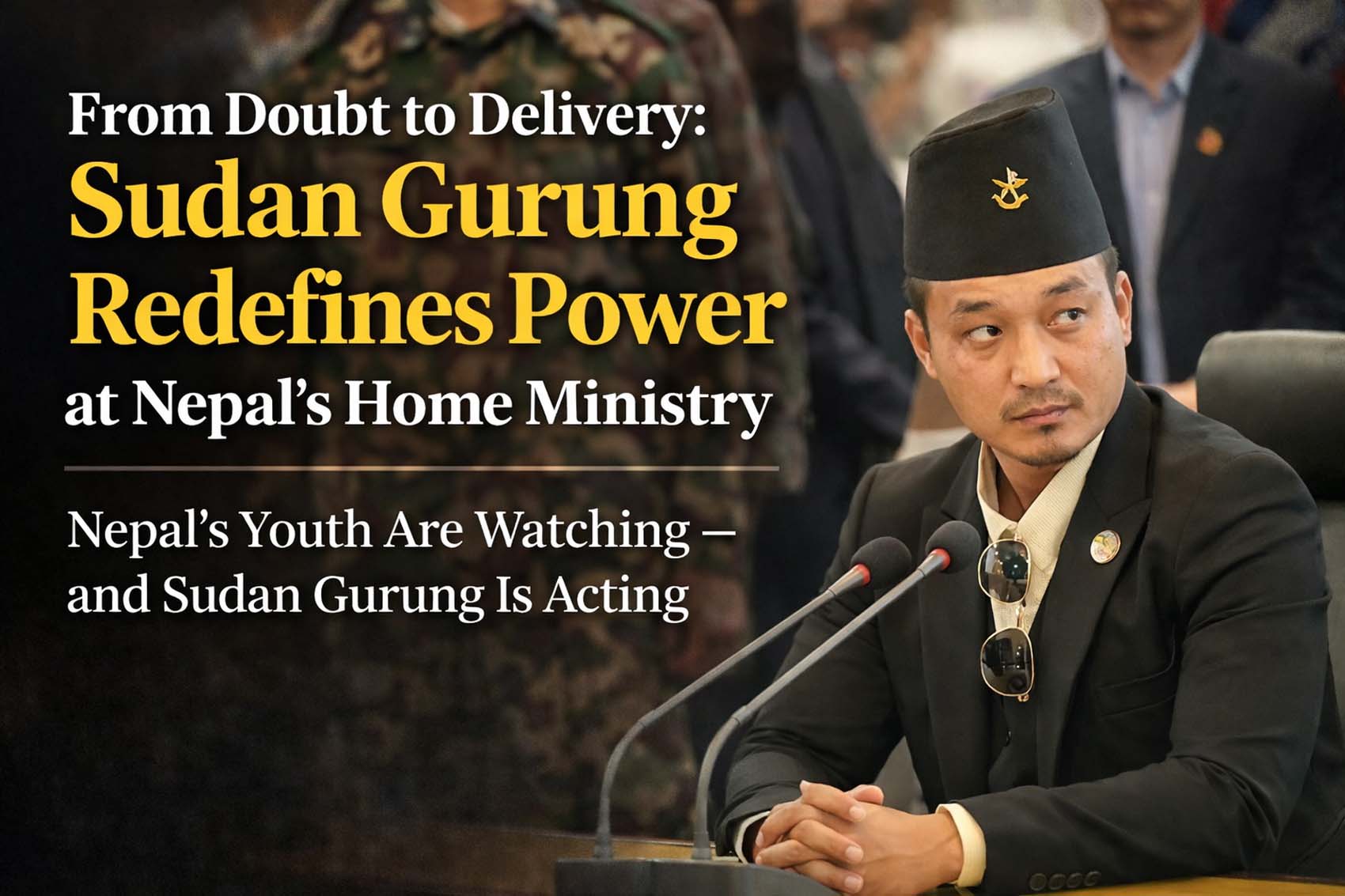
KATHMANDU: When Sudan Gurung stepped into the role of Home Minister, skepticism followed closely behind. His appointment was viewed by many, particularly among politically aware youth as another routine reshuffle in a system often criticized for recycling familiar faces without delivering substantive change.
Within days, that skepticism began to encounter a more complicated reality.
What has emerged instead is a leadership style that blends restraint with decisiveness- a combination that, in recent weeks, has translated into a series of high-profile actions reshaping public perception of Gurung’s tenure.
A Sudden Shift Toward Enforcement
The most striking development has been Gurung’s willingness to authorize actions once considered politically improbable.
In a move that sent shockwaves across Nepal’s political landscape, authorities under his ministry proceeded with the arrest of former Prime Minister KP Sharma Oli in connection with an ongoing Gen Z-linked murder investigation. Shortly thereafter, former Home Minister Ramesh Lekhak was also taken into custody.
While legal processes remain ongoing, these actions have been widely interpreted as an attempt to signal that political stature may no longer guarantee immunity- a message that resonates strongly with younger citizens long frustrated by perceived impunity among elites.
For many, it marked a rare moment where the rhetoric of accountability appeared to align with enforcement.
Beyond High-Profile Arrests
Yet, Gurung’s recent activity has not been limited to headline-making detentions.
In a closed-door briefing with senior police officials, he reportedly emphasized a dual commitment: firm handling of high-profile cases alongside equal attention to everyday law enforcement. The directive to treat both “high-profile and low-profile cases with equal seriousness” reflects a shift toward procedural consistency rather than selective action.
He has also reiterated plans to modernize Nepal’s policing system, with a focus on technological upgrades in investigation processes, data-driven crime monitoring, and professional training aligned with global standards.
Perhaps more notably, Gurung has publicly committed to merit-based promotions within the police force, a longstanding demand among younger officers who have often criticized politicized advancement structures.
Symbolism and Street-Level Politics
If policy signals institutional intent, Gurung’s recent public gestures suggest an awareness of symbolic politics, particularly in a volatile environment shaped by protest movements and generational tensions.
Amid demonstrations by supporters of KP Sharma Oli following his arrest, an incident involving the mistreatment of an elderly civilian drew public attention. Gurung’s subsequent decision to personally meet the individual an act widely circulated on social media - was interpreted as a message of restraint and civic respect.
For a youth audience deeply engaged in digital discourse, such moments carry disproportionate weight. They signal not just authority, but accountability in how that authority is exercised.
Youth Optics: Power, Accountability, and Credibility
Among Nepal’s youth, Gurung’s recent actions are being read through a broader generational lens.
This is a demographic that has grown increasingly impatient with symbolic politics and selective justice. The arrest of powerful figures, coupled with internal reform signals, aligns with a growing demand for systemic fairness rather than episodic enforcement.
Yet, skepticism has not disappeared, it has evolved.
“Young people are watching not just what he does, but whether it continues,” said a media studies graduate in Kathmandu. “One or two bold decisions are not enough. Consistency is everything.”
This conditional support reflects a more mature political consciousness. One that resists both blind optimism and reflexive cynicism.
The Risks of Assertive Governance
Gurung’s recent assertiveness is not without risks.
Targeting high-profile political figures inevitably invites accusations of political bias, selective prosecution, or institutional overreach. In Nepal’s deeply polarized environment, even legally grounded actions can be reframed as partisan maneuvers.
Moreover, systemic reform, particularly within law enforcement requires more than ministerial intent. It demands structural continuity, bureaucratic cooperation, and insulation from political interference.
Whether Gurung can sustain this momentum without triggering institutional pushback remains an open question.
A Defining Test in Real Time
For now, Sudan Gurung’s tenure is entering a critical phase. One defined not by expectations, but by execution.
His recent actions have disrupted initial assumptions, offering a glimpse of what a more assertive, accountability-driven Home Ministry might look like. For Nepal’s youth, this moment is less about celebration and more about evaluation.
Is this the beginning of a structural shift, or a brief departure from the norm?
The answer, as many young observers suggest, will not be found in a single arrest, a single reform, or a single gesture but in whether these actions cohere into a sustained pattern of governance.
Until then, Gurung’s transformation from a doubted appointee to a closely watched actor remains, like much of Nepal’s political evolution, a work in progress unfolding in real time under the scrutiny of a generation unwilling to settle for less.
-

Doctors Suggest Not to Use Toilet Papers
2026-08-18 -

Eight best home remedies for gastritis
2026-08-18 -

Advantages and Disadvantages of Inter-caste Marriage
2026-08-18 -

Top Seven Safe, Effective Natural Antibiotics
2026-08-18 -

Meditation: Techniques, Benefits
2026-08-18 -

4 Ingredients Available At Your Home To Flush Kidney Stones Naturally
2026-08-18 -

1.1 billion people live in slums. Can they be housed in dignity?
2026-05-18 -

International Scholars and Academics Honor Prof. Nirmala Mani Adhikary at Two-Day Golden Jubilee Celebration
2026-05-16 -
From Doubt to Delivery: Sudan Gurung Redefines Power at Nepal’s Home Ministry
2026-04-01 -
Youth Revolt to State Power: Nepal’s Bold Political Experiment Begins
2026-03-27