
Youth Revolt to State Power: Nepal’s Bold Political Experiment Begins
Shah’s rise marks a profound shift in Nepal’s political narrative from hierarchical, party-driven leadership to personality-driven, youth-powered politics.
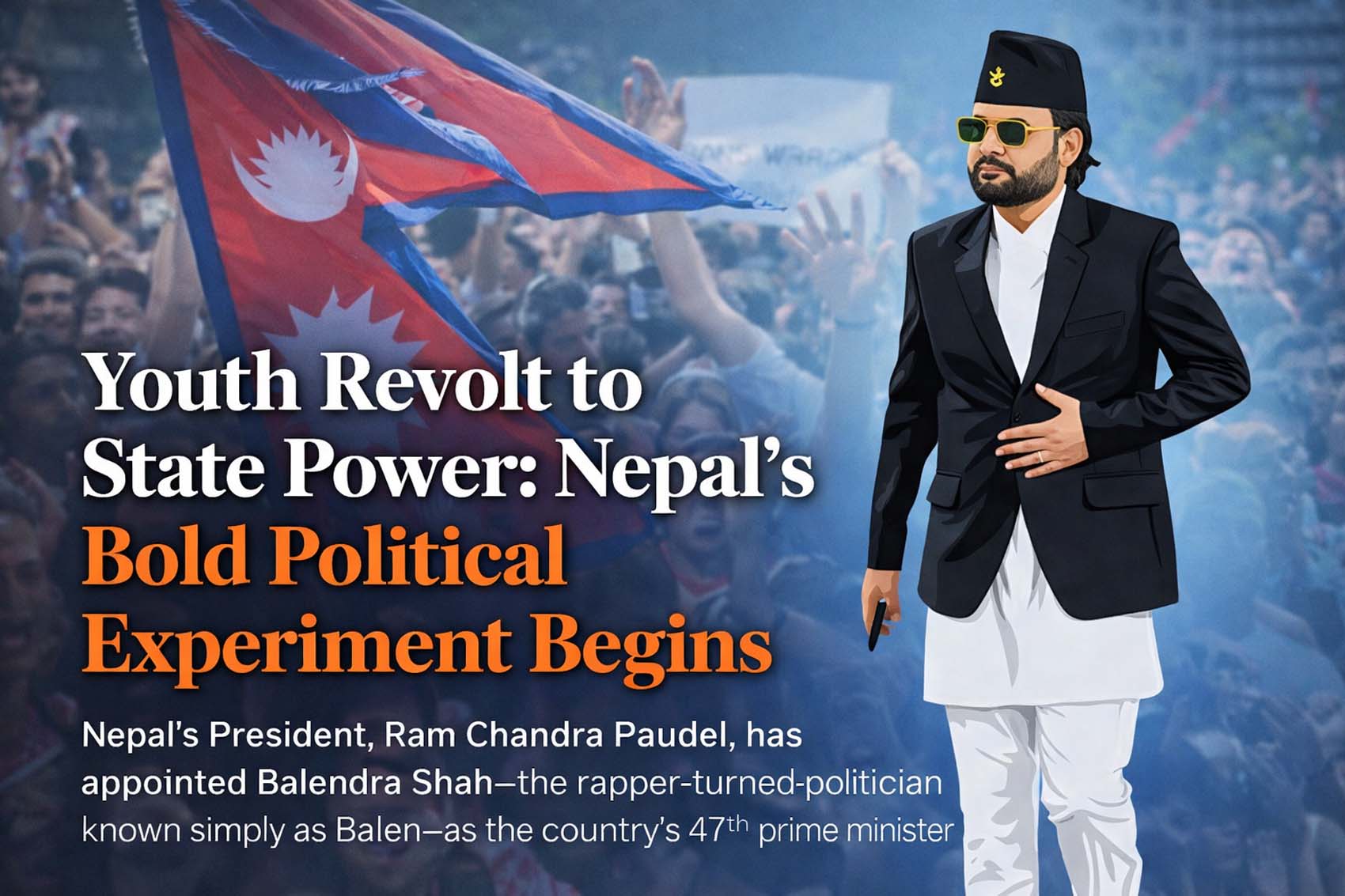
Kathmandu : In a moment charged with generational symbolism and political disruption, Nepal’s President, Ram Chandra Paudel, has appointed Balendra Shah- the rapper-turned-politician known simply as Balen- as the country’s 43rd prime minister.
He has sworn in on Friday, completing a meteoric rise that has transformed him from an underground hip-hop voice into the country’s most powerful elected leader.
A Leader Born from Protest
Shah’s victory follows Nepal’s first national election since last year’s youth-led protests - a wave of civic unrest fueled by anger over corruption, nepotism, and decades of elite-dominated politics. For many young Nepalis, his ascent is not just electoral; it is emotional.
At 35, Shah represents a demographic long excluded from real political power in Nepal. His campaign, driven by digital mobilization and grassroots enthusiasm, tapped into a restless generation demanding accountability and systemic reform.
“This is our moment,” read one viral post shared thousands of times across platforms. “We protested. Now we govern.”
The Rapper Who Spoke What Others Wouldn’t
Long before entering politics, Shah built his identity through music - not as entertainment, but as resistance.
Emerging from Kathmandu’s underground rap scene, he gained national attention in 2013 after winning a major rap battle, delivering sharp, politically charged verses that echoed the frustrations of Nepali youth. His songs confronted corruption, inequality, and the struggles of migrant workers, themes often avoided in mainstream discourse.
One of his most iconic tracks, Balidan (“Sacrifice”), amassed millions of views online. Its lyrics captured a generational disillusionment:
“While we sell our identity abroad… who will pay the debt of people working seven seas away?”
His signature look; square black sunglasses, a black blazer, and unapologetic delivery became symbolic of a rebellious, truth-speaking persona.
Hours before his appointment, Shah released a new rap track with optimistic, defiant, and deeply political.
“Undivided Nepali, this time history is being made,” he declared — a line that quickly spread across social media, garnering more than two million views within hours.
From City Hall to State Power
Shah’s political journey began in earnest in 2022, when he shocked the establishment by winning the Kathmandu mayoral election as an independent candidate. It was a landslide victory against candidates from long-dominant parties.
- Preservation of indigenous heritage
- Anti-corruption drives
- Demolition of illegal structures to ease congestion
While supporters praised his decisiveness, critics pointed to the social costs particularly for informal settlers and street vendors affected by demolition drives.
Yet his image as a results-oriented leader only grew stronger.
The RSP Gamble
In a bold political pivot, Shah joined the Rastriya Swatantra Party (RSP), a relatively new party, as its prime-ministerial candidate. The party, just four years old, rode a wave of anti-establishment sentiment to secure a decisive electoral mandate.
For supporters, the victory signals the collapse of traditional political hierarchies. For skeptics, it raises urgent questions: Can a young party with limited governing experience deliver on its sweeping promises?
The Man Behind the Movement
Born in 1990 in Naradevi, Kathmandu, Shah grew up in a modest household. His father practiced Ayurvedic medicine, while his mother managed the home. The youngest in the family, he pursued engineering studying in Kathmandu and later in Karnataka, India.
He is married and lives with his wife and daughter. A detail often highlighted by supporters to humanize a figure who has otherwise become a political symbol.
Hope, Hype, and Heavy Expectations
Shah’s rise marks a profound shift in Nepal’s political narrative from hierarchical, party-driven leadership to personality-driven, youth-powered politics.
But the transition from protest icon to prime minister comes with enormous pressure.
- Rising youth unemployment
- Institutional inertia
- The complexities of coalition politics
And perhaps most critically the expectations of the very generation that propelled him to power. A New Chapter Or a High-Stakes Experiment?
For now, Kathmandu’s streets and timelines are filled with celebration. But beneath the optimism lies a deeper question: Can disruption translate into durable governance?
As Balen prepares to take the oath of office, Nepal is not just witnessing a change in leadership. It is testing a new political imagination.
For a generation that once rapped along to his lyrics of frustration, the chorus has changed.
Now, they are listening for results.
-

Doctors Suggest Not to Use Toilet Papers
2026-08-18 -

Eight best home remedies for gastritis
2026-08-18 -

Advantages and Disadvantages of Inter-caste Marriage
2026-08-18 -

Top Seven Safe, Effective Natural Antibiotics
2026-08-18 -

Meditation: Techniques, Benefits
2026-08-18 -

4 Ingredients Available At Your Home To Flush Kidney Stones Naturally
2026-08-18 -

1.1 billion people live in slums. Can they be housed in dignity?
2026-05-18 -

International Scholars and Academics Honor Prof. Nirmala Mani Adhikary at Two-Day Golden Jubilee Celebration
2026-05-16 -
From Doubt to Delivery: Sudan Gurung Redefines Power at Nepal’s Home Ministry
2026-04-01 -
Youth Revolt to State Power: Nepal’s Bold Political Experiment Begins
2026-03-27